The Evolution of the Title Insurance Industry
For decades, the title insurance industry operated through a highly localized model. Title agencies built their businesses around specific geographic markets, cultivating relationships with local lenders, realtors, attorneys, and developers. Transactions were handled within relatively narrow jurisdictions, and operational success depended heavily on local market expertise.
That model worked well because real estate itself was largely local.
Today, however, the real estate and mortgage industries operate very differently. Mortgage brokers originate loans across multiple states simultaneously. Institutional investors acquire properties nationwide. National lenders expect uniform execution regardless of jurisdiction. Consumers increasingly demand faster closings, streamlined communication, and technology-enabled experiences.
The problem is that title insurance remains one of the most jurisdictionally fragmented industries in the country.
Every state maintains its own licensing requirements, escrow rules, underwriting expectations, recording customs, and operational regulations. As the mortgage industry became nationalized, title agencies were forced to find ways to support multi-jurisdictional transactions without physically building operations in every state.
That operational challenge gave rise to what the industry now refers to as workshare.
What Is Workshare?
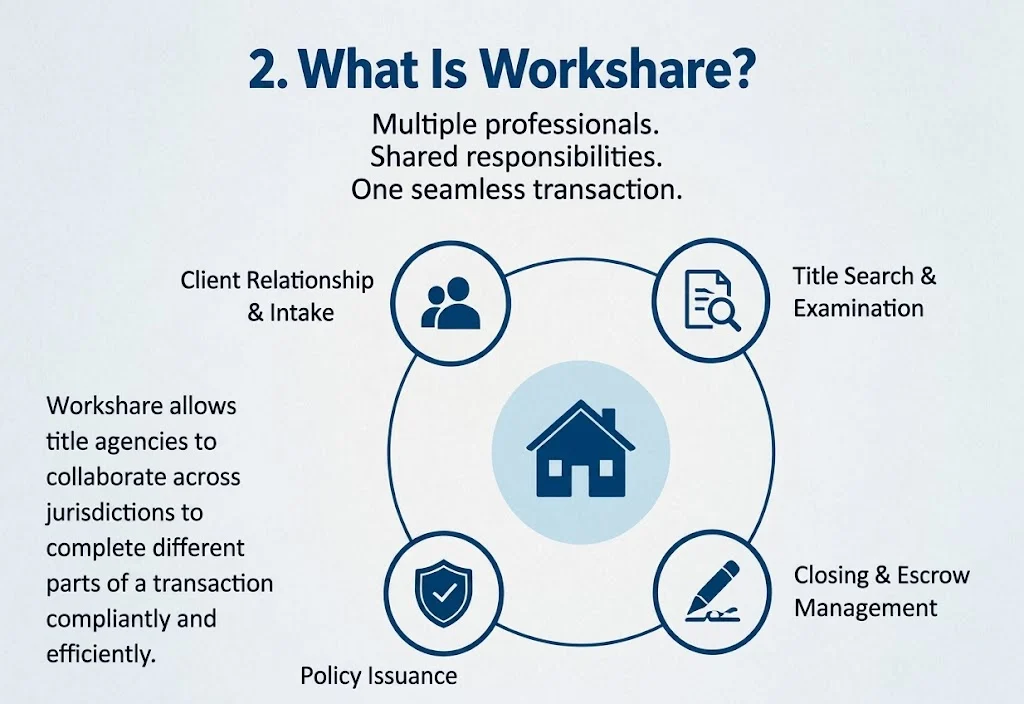
At its core, workshare is a structured operational relationship between title agencies or settlement providers where multiple parties collaborate to complete different portions of a real estate transaction.
Rather than one company performing every function internally, operational responsibilities are distributed among various participants based upon licensing authority, jurisdictional expertise, operational infrastructure, and compliance considerations.
One company may manage the client relationship and intake process. Another may perform the title examination. A separate entity may handle escrow and closing coordination, while another issues the final title insurance policy.
Although the transaction may appear seamless to the lender or borrower, multiple operational participants may be working behind the scenes in a coordinated framework.
Workshare is not simply “sending a file” to another agency. Properly structured workshare involves carefully coordinated operational systems, contractual relationships, underwriting oversight, and compliance controls.
In many respects, it has become the operational infrastructure that allows national real estate commerce to function within a state-regulated title insurance environment.
Why Workshare Became Necessary
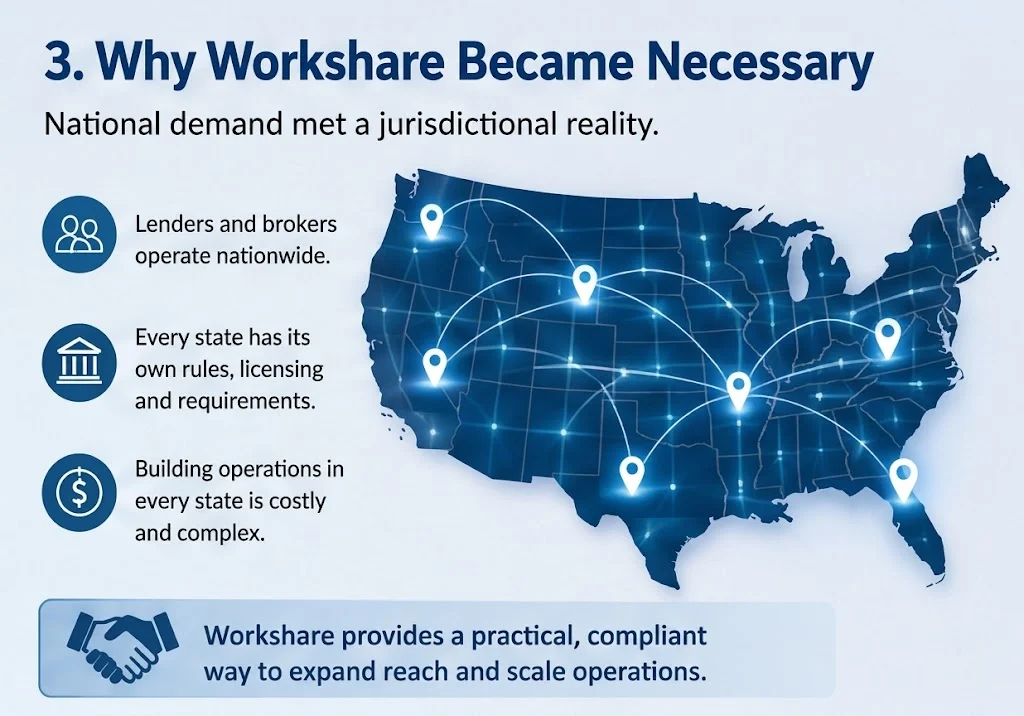
The rise of multi-jurisdictional lending fundamentally changed the operational demands placed upon title agencies.
A mortgage broker in Atlanta may now originate loans in Florida, Texas, Colorado, and Michigan in the same week. National lenders expect one operational point of contact regardless of where the property is located. Real estate investment groups often acquire portfolios spanning numerous states simultaneously.
For title agencies, this creates a significant challenge.
Operating nationally is not simply a matter of marketing or sales. Each state requires separate licensing, compliance oversight, escrow procedures, operational workflows, and underwriter approvals. Building physical infrastructure in every jurisdiction is extraordinarily expensive and operationally complex.
Workshare emerged as the industry’s practical solution to this problem.
Instead of recreating operations in every state, agencies began forming strategic relationships with licensed local operators capable of performing jurisdiction-specific title and settlement services. This allowed companies to expand their reach while preserving local expertise and maintaining regulatory compliance.
Over time, these relationships evolved into sophisticated operational ecosystems capable of supporting national transaction volume.
Traditional Workshare Structures
The most common form of workshare involves operational collaboration between title agencies.
In this structure, one company typically controls the lender, broker, or consumer relationship while another licensed agency performs portions of the operational work required within the applicable jurisdiction.
Responsibilities may include title examination, curative work, escrow handling, closing coordination, recording, or policy issuance. Revenue is allocated according to the services actually being performed and the contractual arrangement governing the relationship.
These structures are especially common among:
From the client’s perspective, the process often appears centralized and unified. Behind the scenes, however, multiple agencies may be coordinating to execute the transaction compliantly and efficiently.
The Rise of Underwriter Networks
Major title insurance underwriters also recognized the growing need for scalable national execution.
As a result, many underwriters began facilitating structured workshare relationships among their appointed agents. These networks allow vetted agencies to collaborate operationally while maintaining underwriting oversight and standardized quality expectations.
Underwriter-supported workshare networks provide several important advantages. They allow local expertise to remain intact while creating a scalable framework for national transaction coordination. They also help ensure operational consistency, underwriting integrity, and compliance discipline across participating agencies.
For growing title companies, participation in these ecosystems can dramatically increase access to transaction volume without requiring immediate brick-and-mortar expansion into every market.
Technology Is Transforming Workshare
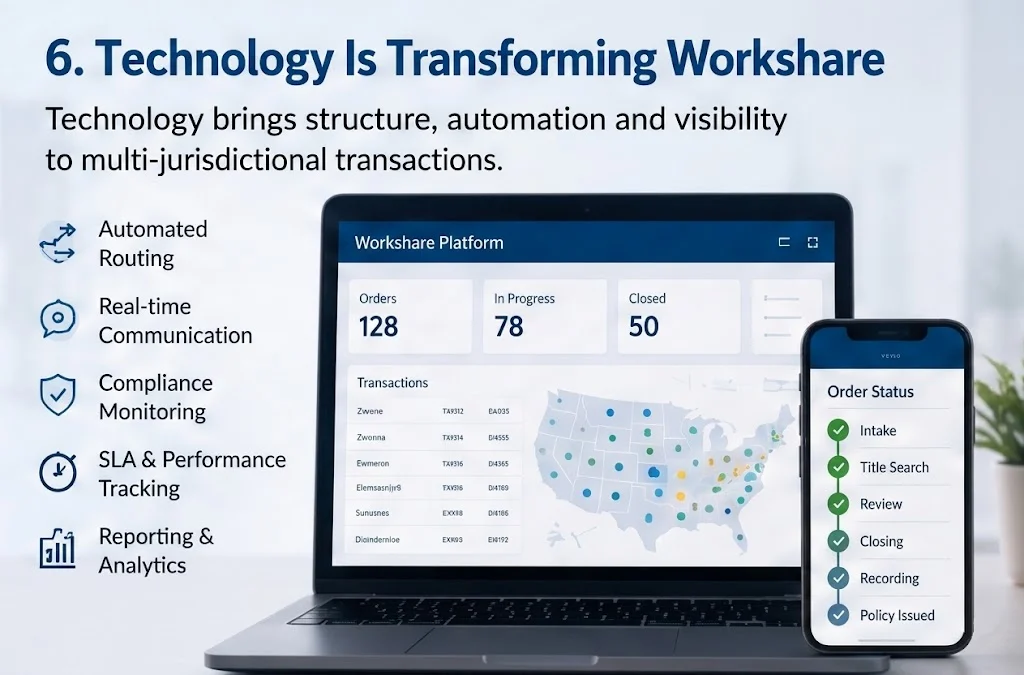
The newest evolution of workshare is being driven by technology.
Modern title platforms increasingly use centralized software systems to orchestrate operational activity across multiple jurisdictions simultaneously. Order intake, workflow routing, communication management, compliance monitoring, vendor coordination, and reporting are now being automated at scale.
In this environment, the actual title and settlement work may still be performed locally, but the operational experience becomes nationally standardized through technology infrastructure.
This shift is important because lenders no longer judge title companies solely based upon licensing footprint. Increasingly, they evaluate operational usability.
They want:
Technology-driven workshare platforms are helping title agencies evolve from fragmented local operations into coordinated national execution systems.
The Compliance Component
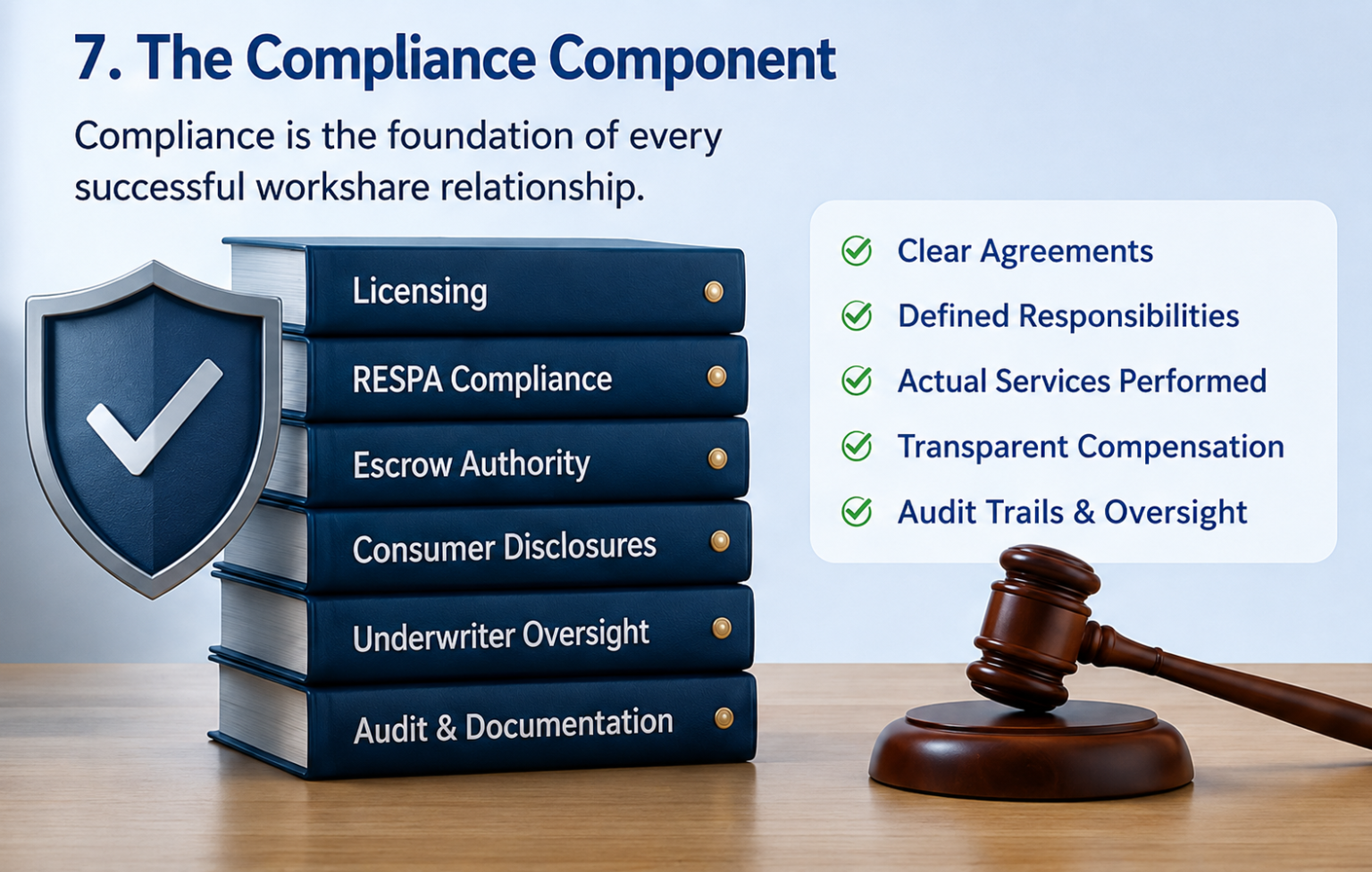
Despite its operational advantages, workshare remains highly sensitive from a regulatory standpoint.
Improperly structured arrangements can create exposure involving:
Because of these risks, compliance is not merely an administrative consideration within workshare systems — it is foundational infrastructure.
Successful workshare environments require clear operational delineation, written agreements, auditability, underwriting supervision, and transparent compensation structures. Regulators and underwriters expect parties to perform legitimate operational services and maintain clear accountability throughout the transaction lifecycle.
The strongest workshare platforms are designed around compliance from the very beginning rather than attempting to retrofit compliance after operational growth occurs.
The Future of National Title Execution
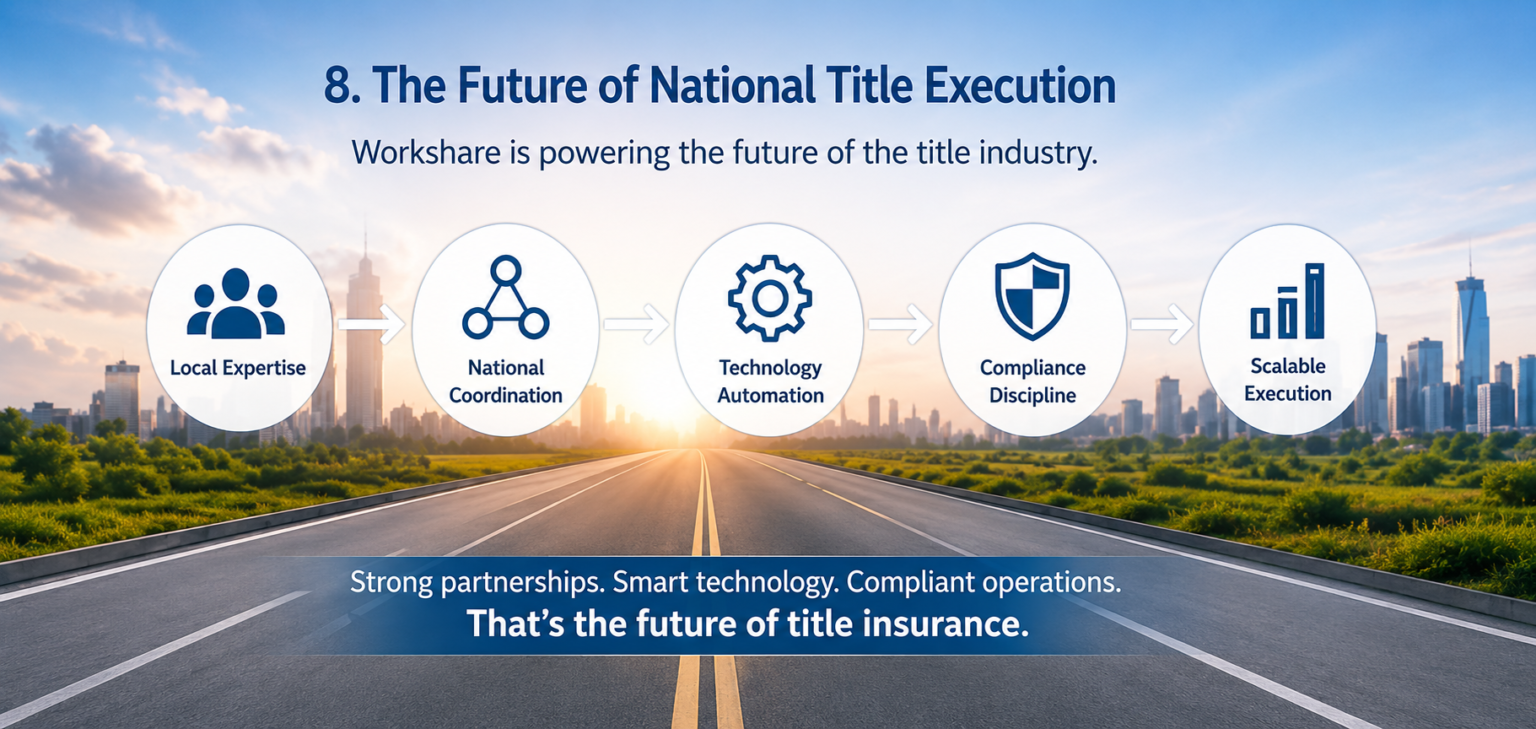
The title insurance industry is entering a period of significant transformation.
The traditional localized operating model is colliding with a market that increasingly demands national coordination, operational speed, technology integration, and scalable execution. Agencies that thrive over the next decade will likely be those capable of combining local expertise with sophisticated operational infrastructure.
Workshare sits at the center of that transformation.
It allows localized title expertise to coexist with national lender demands. It creates scalability without requiring immediate physical expansion into every jurisdiction. Most importantly, it enables the title industry to support a modern national real estate economy while still operating within a fragmented regulatory framework.
In many respects, workshare is no longer simply an operational strategy.
It has become the operational backbone of modern title insurance.
Enter your information to request authorization for sending orders through the Zynova platform.
Provide your details to request an exclusive invitation to our invitation-only national title agency network.
Enter your information to request authorization for sending orders through the Zynova platform.
Enter your information to request an application to Elite 350 Network
Enter your information to request a web demo of the Zynova platform.