The title insurance industry has entered a new era of collaboration. For decades, geographic limitations largely dictated how title agencies conducted business. Agencies operated within the jurisdictions where they were licensed, staffed, and physically present. As real estate transactions became increasingly national in scope, however, those traditional operating models began to evolve. Today, workshare arrangements have become a powerful mechanism for expanding service capabilities, increasing transaction capacity, and leveraging specialized expertise across state lines. Yet as workshare activity has expanded, so too has regulatory scrutiny. What many agencies fail to appreciate is that a workshare transaction is not merely an operational arrangement. It is a regulated activity occurring within one of the most heavily scrutinized sectors of financial services. The difference between a successful workshare relationship and a regulatory investigation often comes down to one factor: compliance guardrails.
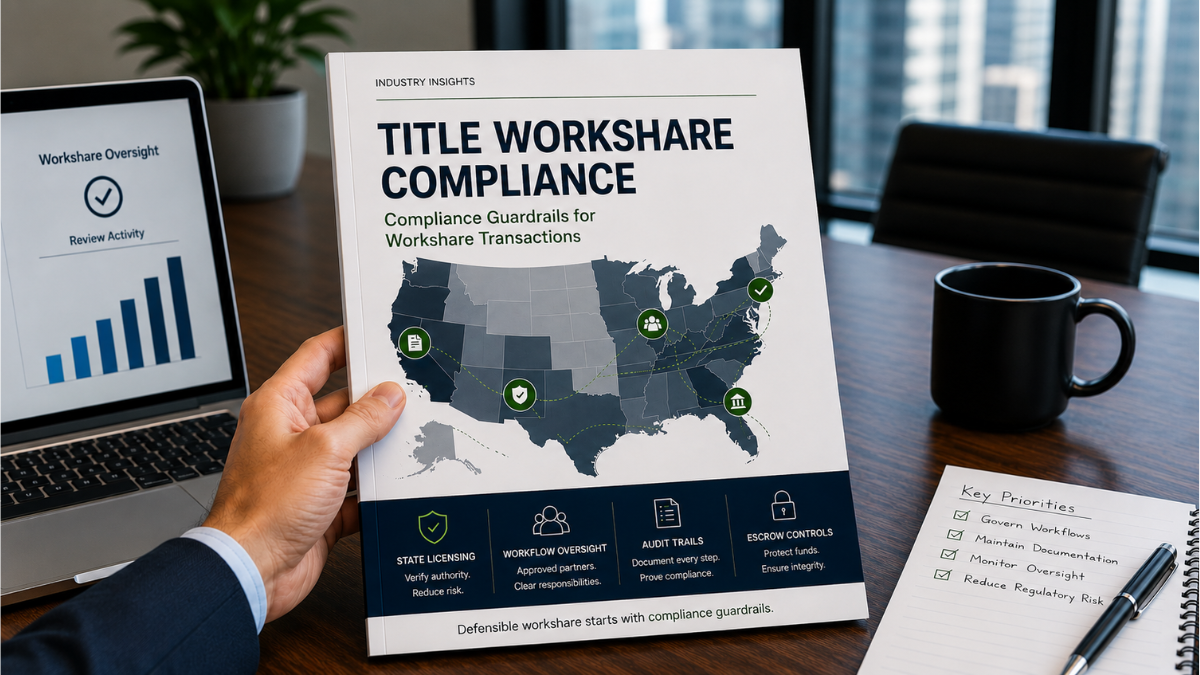
Workshare arrangements have become increasingly common within the title insurance industry. At their best, these arrangements allow agencies to expand geographic reach, increase operational efficiency, leverage specialized expertise, improve turnaround times, reduce fixed costs, and support national lender relationships. However, workshare relationships also introduce unique regulatory, operational, and legal risks. Every transaction involves multiple stakeholders—licensed title agencies, underwriters, escrow professionals, regulators, consumers, and lenders. Each stakeholder operates within a framework of legal obligations and fiduciary responsibilities. Without carefully designed compliance controls, seemingly routine workshare activities can create significant exposure. The industry’s future will not be defined by who participates in workshare. It will be defined by who participates in workshare responsibly.
One of the most common misconceptions surrounding workshare is that it represents a simple outsourcing model. That assumption is dangerous. Title insurance remains a regulated business activity. Regulators generally focus on substance rather than labels. The question is not what parties call a transaction. The question is what actually occurred. Who performed the work? Who exercised control? Who maintained responsibility? Who received compensation? Who interacted with consumers? These questions matter. Regulatory agencies increasingly evaluate workshare arrangements based upon actual operational realities rather than contractual descriptions. Agencies that fail to align agreements with actual performance expose themselves to substantial risk. Effective compliance guardrails ensure operational activity matches documented arrangements.
Workshare becomes significantly more complex when multiple jurisdictions become involved. Each state maintains its own regulatory framework. Requirements frequently differ regarding licensing, escrow activities, title examinations, closings, settlement services, consumer disclosures, and agency supervision. An arrangement considered acceptable in one state may create concerns in another. This creates a challenge for agencies operating nationally. Compliance cannot be treated as a static exercise. It must be dynamic. Organizations must understand not only their own state’s requirements but also the requirements of every jurisdiction participating in the transaction. This is where formal compliance guardrails become critical. Without structured oversight, agencies may unknowingly drift into non-compliant activities.
Perhaps no aspect of workshare attracts greater regulatory attention than compensation. Regulators routinely evaluate whether fees are tied to actual services performed. This issue extends beyond title insurance. It touches broader principles involving consumer protection, fee transparency, service delivery, and regulatory accountability. The underlying principle is straightforward. Compensation should correspond to legitimate work performed. The greater the disconnect between services and compensation, the greater the potential regulatory concern. Well-designed compliance frameworks establish clear documentation regarding scope of services, operational responsibilities, deliverables, workflow ownership, and compensation methodology. Documentation alone is insufficient. The underlying operational reality must support the documentation.
Technology is becoming one of the most important compliance tools available to title agencies. Historically, workshare oversight often depended on manual review. Modern platforms increasingly provide workflow tracking, audit trails, role-based permissions, activity monitoring, transaction documentation, and compliance reporting. These capabilities create unprecedented visibility. Every action can be documented. Every workflow can be monitored. Every transaction can be reviewed. Technology does not eliminate compliance risk. It does make compliance easier to demonstrate. The agencies that leverage technology effectively often possess stronger defensibility during audits and regulatory examinations. This trend is likely to accelerate as workshare networks continue expanding.
Many agencies believe compliance begins and ends with drafting an agreement. The reality is far more complex. An agreement establishes expectations. Governance ensures those expectations are followed. Effective governance typically includes internal policies, training programs, transaction reviews, audit procedures, escalation protocols, vendor oversight, and periodic compliance assessments. Organizations with strong governance structures tend to identify issues before regulators do. Organizations lacking governance often discover problems only after they become significant. In highly regulated industries, governance frequently determines outcomes. The title insurance industry is no exception.
Workshare activity will likely continue expanding. National lenders increasingly demand broader geographic coverage. Agencies seek operational efficiency. Technology continues removing geographic barriers. These forces support continued growth. At the same time, regulatory oversight is likely to increase. Consumer protection remains a priority. Compliance expectations continue rising. The agencies that succeed will be those capable of balancing innovation with accountability. Workshare is becoming a strategic capability. Compliance guardrails ensure that capability remains sustainable.
Agency leaders should evaluate workshare relationships through a compliance lens rather than solely an operational lens. Key questions include: Are responsibilities clearly defined? Are services properly documented? Does compensation align with work performed? Are audit trails maintained? Are workflows monitored? Are state-specific requirements addressed? Organizations that proactively answer these questions are generally better positioned for long-term success.
The future of workshare will likely be shaped by three forces: technology, regulation, and scale. As workshare networks become increasingly sophisticated, regulators will expect greater transparency and accountability. Technology platforms will continue introducing stronger monitoring capabilities. Agencies that embrace both innovation and compliance will possess a meaningful competitive advantage. The future belongs not simply to those who participate in workshare. It belongs to those who can prove they are doing it correctly.
Workshare has become an important component of modern title insurance operations. Its benefits are substantial. Its risks are real. The difference between opportunity and exposure often comes down to compliance guardrails. Strong agreements, effective governance, documented workflows, technology-enabled oversight, and ongoing compliance monitoring create the foundation for sustainable workshare success. As the title insurance industry continues evolving, compliance will remain the mechanism that transforms workshare from a regulatory risk into a strategic asset.
Q: Why are compliance guardrails important in workshare transactions?
A: Compliance guardrails help ensure that operational activity, compensation, licensing, and service delivery remain aligned with regulatory expectations and contractual obligations—reducing exposure and supporting sustainable collaboration.
Q: What is the greatest compliance risk in a workshare arrangement?
A: Misalignment between actual services performed and compensation received often attracts significant regulatory scrutiny, particularly when documentation fails to support operational realities.
Q: How does technology improve workshare compliance?
A: Technology creates audit trails, workflow visibility, transaction monitoring, and reporting capabilities that support regulatory defensibility and enable agencies to demonstrate compliance with greater precision and efficiency.
Q: Are workshare regulations consistent across all states?
A: No. Requirements frequently vary by jurisdiction regarding licensing, escrow activities, supervision, and compensation structures, making multi-state compliance particularly important and complex.
Q: What role does governance play in workshare compliance?
A: Governance ensures policies, procedures, training, audits, and oversight mechanisms are consistently applied throughout the organization—transforming documented expectations into operational reality.
Enter your information to request authorization for sending orders through the Zynova platform.
Provide your details to request an exclusive invitation to our invitation-only national title agency network.
Enter your information to request authorization for sending orders through the Zynova platform.
Enter your information to request an application to Elite 350 Network
Enter your information to request a web demo of the Zynova platform.